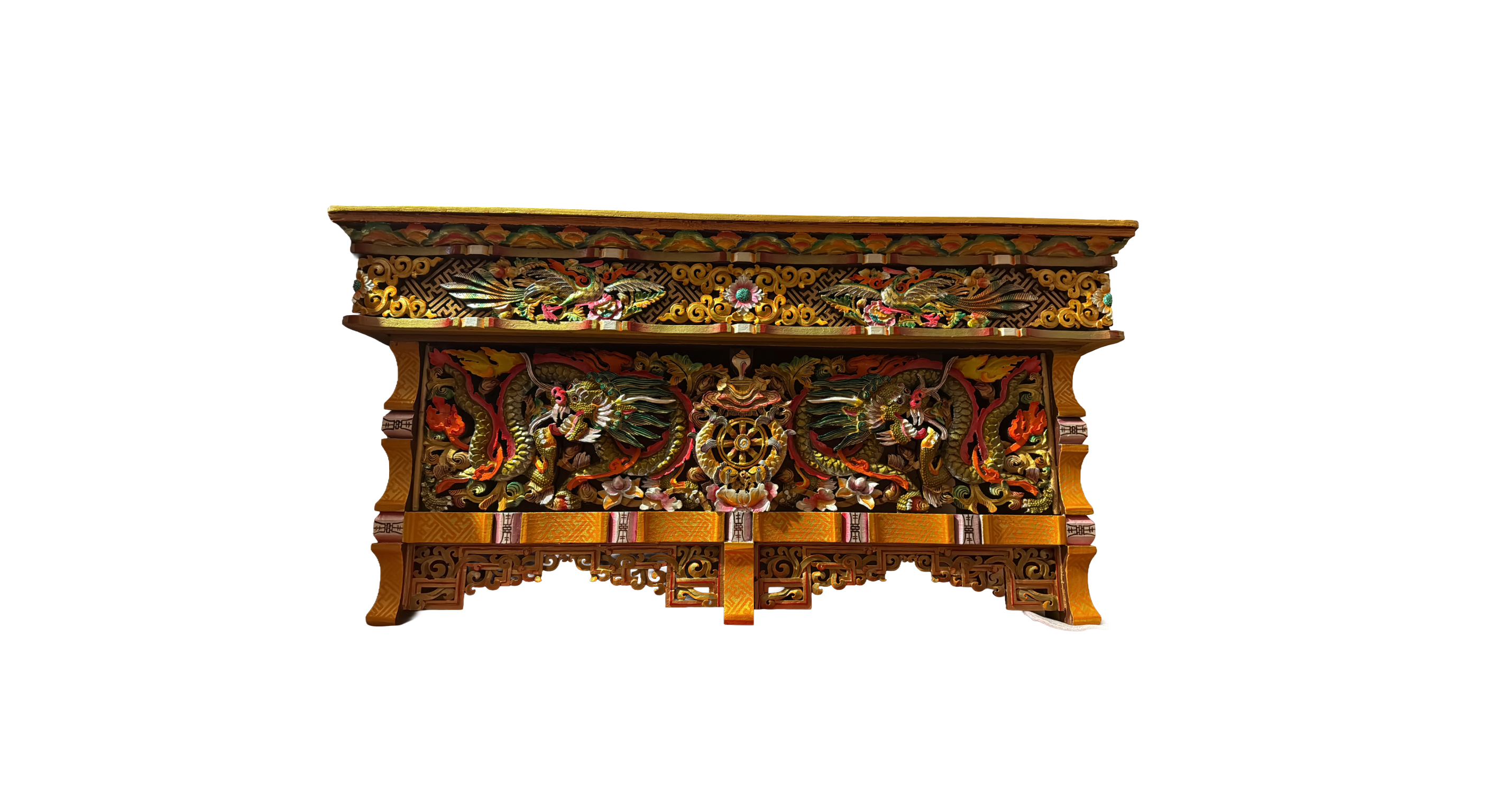
The Heritage and Origin Story: A Portable Sanctuary
The history of the Choktse is inextricably linked to the nomadic and monastic traditions of the Himalayas. While these small, low rectangular tables originated in Tibet, they have evolved into a deeply rooted traditional craft in Ladakh, reflecting local history and culture.
Originally, they were designed for nomadic monks who required a furniture system that was both dignified enough for sacred texts (Pecha) and portable enough to be carried across mountain passes on yaks or horses. A Choktse acted as a sacred altar of the exact right height that could be easily folded and transported across the rugged Himalayan terrain, turning any simple shelter into a consecrated space.
Heritage Note
The word 'Chok' (altar) and 'Tse' (small) defines its purpose. In ancient times, a lama's status was often recognized by the height and intricacy of his Choktse during high-altitude teachings.
Design Mechanics: The Clever Fold
Unlike mass-produced furniture, a true Choktse table in Ladakh utilizes an ingenious foldable design. It typically features a solid top panel and three hinged side panels (aprons) that fold inward, allowing the table to lay completely flat for storage or transport.
Our workshop uses traditional woodworking methods such as dovetailing corner construction and tenoned crossbars, providing the structural rigidity needed to support heavy ritual objects. This "wooden logic" ensures the table never rusts or loosens in the extreme dryness of the high-altitude desert.
This mobility allowed the Buddhist core to remain anchored even in the most remote valleys, turning any simple shelter into a consecrated space—the original "IKEA" of the Himalayas, but built for the divine.
Authentic Materials and Craftsmanship
The crafting of a Choktse is a slow, meditative process known locally as Shingskos. At Ladakh Wood Works, our master artisans undergo years of training before they are permitted to chisel the primary panels using specialized traditional tools like ikas (straight tools for borders) and tikkyu (curved tools for organic details) to create a striking, elevating three-dimensional effect.
The Wood: Willow (Malchang), Apricot, and Walnut
The choice of wood defines the Choktse's character, and we prioritize locally sourced high-altitude timber:
- Local Ladakhi Willow (Malchang): The absolute premium choice. Significantly more expensive and of the highest quality for Shingskos carving. Its grain is perfectly adapted to the Leh climate and remains remarkably stable.
- Zanskar Walnut: Valued for its dense grain and natural luster. It is highly sought after for intricate micro-details and creates an heirloom-quality finish.
- Apricot Wood: A traditional "stability standard" in Ladakh. It is a dense, tight-grain wood that does not crack in the dry mountain air, ensuring intricate carvings remain intact for generations.
Once carved, the tables are rigorously sanded, coated with primer, and finally hand-painted with vibrant, traditional mineral colors before being polished to protect the wood's natural integrity.
Sacred Symbolism and Iconography: The Dukkhabral Motif
The motifs found in authentic Shingskos carry profound spiritual and philosophical meaning. Far from being merely decorative, each carving acts as a visual prayer and protective seal. The primary iconography includes:
- The Dukkhabral (Twin Protective Dragons): A highly revered iconographic layout featuring two symmetric dragons carved in high relief, facing each other across a central jewel. The term Dukkhabral translates to the dispelling of worldly suffering (dukkha). The open-mouthed dragons represent the sound of thunder dispelling ignorance, acting as cosmic guardians that shield the home from negative energy and spiritual obstacles.
- The Ashtamangala (Eight Auspicious Symbols): The classic Buddhist canvas of blessings:
- Padma (The Lotus) representing purity and enlightenment.
- Shrivatsa (The Endless Knot) signifying the infinite wisdom and interconnectedness of all existence.
- Dharmachakra (The Wheel of Dharma) representing the Buddha's teachings.
- Sankha (The Conch Shell) symbolizing the far-reaching sound of the Dharma.
- The Sengge (Snow Lion): Representing the fearless energy, high-altitude cheerfulness, and absolute freedom of the Himalayas, often carved on the side aprons to support the altar physically and spiritually.
The Master Craftsman’s Intel: Investigating the "Soul"
When you dig past the standard descriptions, you find the most critical secret of Himalayan furniture: The Memory of Altitude.
Density Check
High-altitude wood is denser because trees grow slowly in the thin air. This natural seasoning is why a Ladakh-built Choktse survives centrally heated city apartments better than lowland wood.
The "Living" Wood: Mulberry, Birch, and Walnut Density
Authentic Choktses from high-altitude regions are traditionally made from Mulberry (Toot), Bhojpatra (Birch), or Zanskar Walnut. These woods are chosen because they don't crack in the extreme dry-cold of the Himalayas. They are "tight-grain" woods that expand and contract in a uniform, predictable manner.
Technical Breakdown of Timber Performance:
| Species | Density (kg/m³) | Climate Resilience | Carving Fidelity |
|---|---|---|---|
| Himalayan Mulberry | 650 - 720 | Extreme High (Anti-cracking) | High Relief |
| Zanskar Walnut | 680 - 750 | Moderate-High (Stable) | Micro-details |
| Birch (Bhojpatra) | 620 - 700 | High (Flexible) | Smooth Finish |
In contrast, many modern replicas use Pine or MDF. While these look identical when fresh, they are structurally incompatible with many climates. Pine "weeps" resin in humid city environments, causing the beautiful mineral paint to bubble and peel from the inside out. MDF is even more problematic, swelling irreversibly if exposed to even a hint of moisture.
Symbolic Joinery: The Physics of the "No-Nails" Philosophy
In authentic heirloom pieces, no metallic nails, screws, or brackets are used. This is not merely a stylistic choice; it is a vital requirement of high-altitude structural engineering. The high-altitude valleys of Leh experience dramatic temperature and humidity swings, with winter temperatures plunging to -30°C and summers reaching +30°C.
Wood is a hygroscopic, cellular material. It absorbs and releases moisture, expanding and contracting across its grain. Metal, on the other hand, is completely rigid and responds to temperature shifts at a vastly different coefficient of expansion than wood. In a climate like Ladakh's, a metal nail driven into a wooden joint will act as a structural wedge. As the wood swells and shrinks, the nail remains static, crushing the surrounding wood cells, loosening the joint, and ultimately splitting the timber.
To prevent this, authentic Choktses utilize the Mugher method — hand-carved wooden pegs and double-locked sliding dovetails. The peg and mortise are fashioned from the same wood species as the frame. This ensures that every component of the joint expands and contracts at the exact same rate and in the exact same vector. The table literally "breathes" as a single unified organism, maintaining its structural integrity and absolute rigidity for centuries.
The "Secret" Drawer: Hidden Protection
A fascinating detail of heirloom Choktses is the presence of a Secret Drawer or a hidden tension-release slat. Historically, some pieces featured a "blind" drawer underneath the top panel for storing Dhvaja (prayer scrolls) or protection amulets. These are considered too sacred to be touched by laypeople, turning the table into a private sanctuary.
5. Ergonomic Wisdom: The Seating Gap
A Choktse is an ergonomic instrument calibrated for Himalayan posture. Most modern users find them "too low" because they lack the correct pairing:
The Golden Ratio: A standard 12-inch high Choktse is specifically designed to be paired with a Gomden (Meditation Cushion) that is 4 to 5 inches high. This 7-8 inch differential is the secret to spinal alignment during long sessions of tea or meditation. Without this pairing, the ergonomic benefit is lost.
6. Regional Style Comparison: Ladakh vs. Sikkim Choktses
To the untrained eye, Himalayan folding altar tables might look similar. However, discerning collectors and curators recognize distinct differences between the **Ladakh (Leh-style)** and **Sikkim (Gangtok-style)** traditions. Below is the technical comparison:
| Technical Variable | Ladakh Choktse (Shingskos) | Sikkim Choktse |
|---|---|---|
| Primary Timber Species | High-altitude Malchang (Willow) or dense Walnut. Extremely stable under low-humidity centrally heated environments. | Temperate pine, birch, or mixed Eastern Himalayan softwoods. Heavier but more prone to weeping resin in dry heat. |
| Carving Depth & Style | Deep high-relief 3D carving (up to 1 inch depth). Extremely dense iconography with deep undercuts. | Shallow relief or open-work lattice. Flat-relief stenciling is more common in modern Sikkim pieces. |
| Joinery Technique | Strictly nail-free Mugher pegged tenons and double-sliding dovetails designed for dry desert air. | Combination of sliding joints, brass hinges, and occasionally concealed steel wire or screws. |
| Paint Finish | Velvety matte finish using ground mineral pigments (Lapis, Malachite) mixed with natural binders. | Vibrant, semi-glossy or glossy lacquer finishes, often multi-layered to withstand higher humidity. |
7. Traditional and Modern Uses
While the Choktse was born in the mountains, its versatile design makes it a stunning addition to contemporary living spaces:
- As a Spiritual Altar: In traditional homes, the Choktse is the heart of the Chosham (worship room), used to hold scriptures (Pecha), ritual bells, or the Yonchap (the traditional seven-bowl water offering).
- As a Centerpiece of Hospitality: During festivals like Losar (the New Year) or when welcoming guests, Choktse tables are lined up to serve chang (millet beer), tea, and snacks.
- Modern Décor: Due to their compact size and foldable design, they make excellent coffee tables, side tables, or unique accent pieces in modern interiors.
8. Care and Maintenance Guide
A Choktse is an investment designed to last over a century. To preserve its beauty and structural integrity in modern environments, follow these artisan-approved tips:
- Environment: Wood expands and contracts. Keep the table in a stable environment with 40-60% humidity and away from direct sunlight, heating vents, or fireplaces to prevent fading, warping, or cracking.
- Cleaning: Dust regularly with a soft, dry microfiber cloth or a clean, soft-bristled brush for the deep crevices. Never use harsh chemicals, alcohol, or commercial silicone sprays—they can ruin traditional pigments.
- Nourishing: Occasionally condition the wood with pure, cold-pressed linseed oil or a blend of beeswax and oil to maintain its luster. Apply sparingly with the grain and always use coasters for beverages.
The Quality Checklist
| Feature | The Artisan Way | The Mass-Market Cheat |
|---|---|---|
| Material | Solid Willow, Apricot or Walnut | Pine or sawdust-based MDF |
| Joinery | Dovetails & Pegged Tenons | Metal screws and nails |
| Pigments | Multi-layer Mineral Paints | Water-transfer decals/stickers |
| Hinges | Heavy-duty custom brass | Undersized, flimsy steel |
Red Flag: "Plaster" Filling. Rap your knuckles on the carved areas. A deep "ring" indicates solid wood. A dull "thud" usually indicates the presence of heavy filler hiding cracks.
9. The Artisan Legacy: Meet the Masters of Leh
Behind every Ladakh Wood Works piece is a lineage. In our workshop near the Leh Palace, master woodcarvers like Tsetan Namgyal oversee the production. Tsetan is a third-generation artisan whose grandfather carved pieces for the Hemis Monastery. This transfer of knowledge includes the "Eye for the Grain"—the ability to look at a raw slab of Mulberry and know exactly how the Dragon's tail will curve along the wood's natural fibers.
10. The Purity of Pigment: Matte vs. Gloss
The finish of a Choktse is where the "Artisanal" separates from the "Commercial."
- Mineral Patina (Authentic): We use cold-pressed mineral pigments—Lapis Lazuli (Blue), Malachite (Green), and Cinnabar (Red)—mixed with natural hide glue. This creates a velvety, matte texture that lets the wood grain breathe and improves with age.
- Synthetic Enamel (Mass-Market): Cheap replicas use glossy chemical sprays. These "choke" the wood fibers, eventually causing the paint to bubble and peel under the dry Leh sun.
At Ladakh Wood Works, we prioritize the royal matte finish of authentic mineral paints.
11. The Connoisseur’s Eye: Spotting Antique vs. Heirloom-New
For many collectors, the question is whether to seek an antique piece or commission a new one. Here is how to distinguish a 50-year-old authentic Choktse from a "distressed" modern replica:
Authentication Markers:
1. Soot Reside: Authentic antiques often have a thin, almost invisible layer of butter-lamp soot embedded in the deeper crevices of the relief carving. This cannot be easily faked with paint.
2. Hinge Patina: Look at the brass hinges. On an antique, the brass will have "grown" into the wood, with slight green oxidation (verdigris) where it meets the fiber. Modern "aged" hinges often look uniform and artificial.
3. Wear Patterns: A genuine antique will show wear at the center of the top panel (where books were placed) and at the base of the legs. If the "distressing" is found in areas a human hand or book would never touch, it is a replica.
12. Monastery Commissions: The Gold Standard
Perhaps the greatest testament to our quality is our history of Monastery Commissions. Ladakh Wood Works has been privileged to create ceremonial Choktses and Pecha-holders for institutions such as Hemis, Thiksey, and Alchi Monasteries. When a Rinpoche or a monastic community requires furniture for a main prayer hall, they demand the same sliding-dovetail joinery and mineral pigments we offer to our global clients. This "Monastery Standard" is the benchmark for everything we produce.
13. Inside the Leh Workshop: A Master’s Walkthrough
If you were to step into our workshop near the Golden Bakery in Leh, you would immediately notice the absence of heavy machinery. Our process remains grounded in the *Shingskos* (woodcarving) tradition. The air is thick with the scent of seasoned Walnut and the rhythmic ‘tink-tink’ of small mallets meeting iron chisels.
Our workshop is divided into four distinct stations, each overseen by a specialist:
- The Seasoning Room: Where raw slabs of Mulberry and Walnut are air-dried for up to 18 months. We reject 30% of moisture-rich wood that doesn't meet our "Himalayan Standard."
- The Layout Floor: Here, the master artist uses charcoal pencils to sketch the motifs directly onto the wood. No stencils are used; the design is adapted to the specific grain of each slab.
- The Cutting Pit: Where the 3D relief carving happens. Artisans use up to 40 different types of chisels to achieve the "dragon-scale" texture.
- The Pigment Lab: Where the mineral colors are ground and mixed with natural resins to create the final, vibrantly colored finish.
14. Museum-Grade Shipping: From Leh to the World
Every Choktse is vacuum-sealed in moisture-barrier bags and crated in marine-grade plywood to protect the folding wooden pivots during global transit. We ensure your heritage piece arrives ready for the next century.
15. Acquisition & Consultation
Because each authentic Choktse is a unique commission based on wood density and carving depth, we do not provide public pricing. Every collector receives a private consultation.
AUTHENTIC CHOKTSE STARTING FROM ₹5,999
Our website only displays a fraction of our artisan's work. We have a diverse range of Choktse designs in stock — from compact altar tables to ceremonial monastery-grade commissions. Please contact us directly to view the full available collection or discuss a custom commission.
Direct Consult with Master Artisans in Leh
16. Verified Heritage Resources
For research and authentication, we recommend consulting the following authoritative bodies:
• Handicrafts of India (Ministry of Textiles)
• Asia Inch: Himalayan Heritage Foundation
• UNESCO Intangible Cultural Heritage Registry