Heritage Collection · Leh, Ladakh
Artifacts & Souvenirs
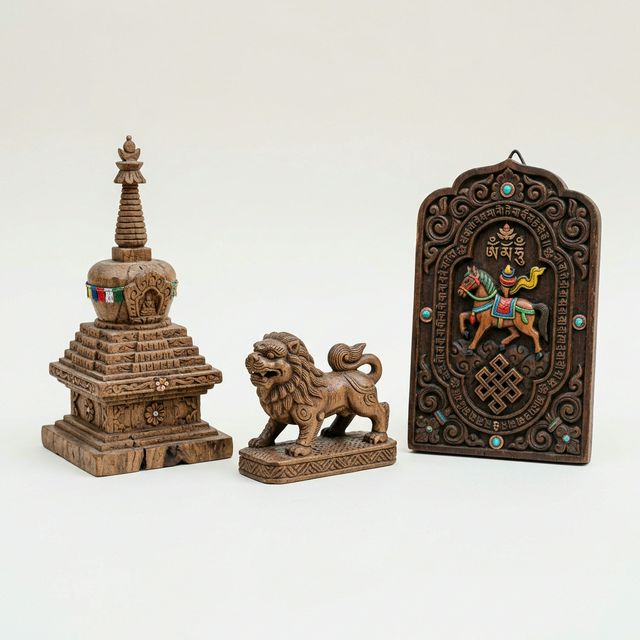
Miniature stupas (Chortens), hand-carved picture frames, prayer wheels, and Buddhist symbols. Authentic heritage gifts crafted directly in Leh by traditional master artisans, carrying the spiritual weight of the Himalayas.
About the Craft
Our smaller artifacts carry the exact same level of mastery as our grand architectural works. Each piece is a genuine fragment of Ladakhi heritage, perfect for gifting, home decor, or gracing personal altars across the world. They represent an unbroken chain of artistry spanning generations.
Master Craftsmanship
Carved by the very same artisans who restore and build ancient Himalayan monasteries.
Authentic Materials
Expertly fashioned from local Willow, fragrant Apricot, and premium Walnut wood.
Direct from Leh
Shipped globally from our high-altitude workshop directly to your doorstep.
History of the Craft
The creation of small religious and cultural artifacts in Ladakh is a tradition that predates modern tourism by centuries. Historically, nomadic traders traversing the Silk Route and devoted pilgrims visiting sacred shrines required portable items of veneration. Small Chortens (stupas), prayer wheels, and protective amulets were meticulously carved to endure arduous journeys across the high mountain passes.
These items served a dual purpose: they were indispensable spiritual companions for travelers facing the perils of the Himalayas, and they acted as a medium for transmitting Buddhist teachings across vast distances. The artisans of Leh became renowned for their ability to condense immense spiritual and architectural complexity into miniature forms without losing the profound sacredness of the design.
At Ladakh Wood Works, we honor this ancient tradition. The souvenirs and artifacts we produce today are not mass-manufactured trinkets; they are authentic continuations of this historical craft. By acquiring one of our pieces, you are not merely buying a memento of the Himalayas, but participating in the preservation of a living, breathing cultural heritage that has survived in these remote mountains for generations. Our carvers apply the exact same devotion to these small pieces as they do to monumental monastic pillars.
Symbolism & Iconography
Every artifact we carve is rich with meaning, drawing upon the vast wellspring of Tibetan Buddhist iconography. Our miniature Chortens, for example, are exact scale models of the monumental stupas found across Ladakh. They represent the enlightened mind of the Buddha, with the base symbolizing earth, the dome water, the spire fire, the crescent air, and the pinnacle space.
Our hand-carved picture frames frequently incorporate the intricate 'Endless Knot' or 'Snow Lion' motifs. The Snow Lion, a celestial animal of Tibet, represents fearlessness, unconditional cheerfulness, and the vibrant energy of the earth element. Frames adorned with these symbols are designed not just to hold a photograph, but to frame it within an aura of spiritual protection and auspiciousness.
We also specialize in carving intricate wall hangings depicting the 'Four Harmonious Friends' (Thunpa Punzhi), a classic Himalayan fable illustrating the virtues of respect, cooperation, and social harmony. Through these symbols, our artifacts transcend their material form, serving as constant, silent teachers of profound philosophical concepts within your home, resonating with a timeless spiritual frequency.
Materials Used
The integrity of a Ladakhi woodcraft piece begins with the selection of the wood. We utilize timber that is deeply connected to the local ecosystem and culture. Apricot wood (Chuli) is highly favored for smaller, intricate artifacts. It possesses a beautiful, warm hue and a subtle, natural fragrance that lingers long after the carving is complete. In Ladakh, the apricot tree is a symbol of resilience, thriving in the harsh desert environment, and its wood carries that same enduring strength.
Himalayan Walnut is reserved for our most premium artifacts. Its dark, swirling grain provides a stunning contrast to deeply carved reliefs, and its exceptional hardness allows our master carvers to execute microscopic details that will not wear down over time. We also utilize seasoned Willow for specific traditional items, a wood that has been a staple in Ladakhi construction and craft for millennia.
All our timber is ethically sourced and subjected to a rigorous, natural air-drying process in the arid Ladakhi climate. This slow seasoning is crucial; it stabilizes the wood at a cellular level, ensuring that your artifact will not crack or warp when transported to different climates around the world. The pieces are finished with natural oils, enhancing the grain while remaining environmentally and spiritually pure. We avoid synthetic varnishes to allow the wood to breathe and age gracefully.
The Carving Process
The creation of a Ladakh Wood Works artifact is an exercise in extreme patience and precision. Unlike large furniture pieces, miniature carving requires the artisan to work on a microscopic scale, often utilizing custom-made, fine-tipped chisels that are sharpened daily to maintain a razor edge. The process is entirely manual, demanding intense concentration and a steady hand, qualities cultivated through years of disciplined practice.
For a piece like a miniature Chorten, the wood is first turned on a traditional lathe to achieve perfect symmetry. Once the foundational geometry is established, the master carver takes over. The complex architectural tiers of the stupa are painstakingly carved, layer by layer, ensuring precise proportions according to ancient religious texts. This is not merely a technical process, but a meditative one, often accompanied by the quiet chanting of mantras in our workshop.
The final detailing involves defining the sharpest edges and ensuring the depth of the relief is consistent. The piece is then carefully sanded by hand, moving through progressively finer grits until the wood achieves a silken texture. The application of natural oil is the final step, bringing the dormant grain to life and sealing the artifact for generations of appreciation. We take immense pride in knowing that each cut of the chisel represents a breath, a moment of focus, and a dedication to perfection.
Global Connection to Ladakh
Owning a piece of handcrafted Ladakhi artifact is more than a decorative choice; it is a profound connection to the "Roof of the World." As modernization sweeps across the globe, traditional arts are increasingly rare. By choosing an authentic, hand-carved souvenir, you are standing against the tide of mass production and affirming the value of human touch, spiritual intent, and localized artisanship.
These pieces bring the quiet, majestic atmosphere of the high Himalayas into your living room or study. They serve as daily reminders of the principles they embody: mindfulness, compassion, and the enduring beauty of the natural world. Many of our international clients tell us that their Ladakhi artifacts become central focal points in their homes, initiating conversations about art, spirituality, and travel.
Furthermore, your patronage directly empowers the local artisan community in Leh. It ensures that master carvers can sustain their livelihoods and that young apprentices are encouraged to learn the trade. In this way, every artifact is not just a beautiful object, but a vital thread in the living heritage of Ladakh.
Frequently Asked Questions
Are these artifacts authentic to Ladakh? +
Absolutely. Every piece is hand-carved in our workshop in Leh, Ladakh, by local master artisans using regionally sourced timber. We are completely dedicated to preserving the authentic artistic heritage of the Himalayas.
Do you accept custom orders for specific souvenirs? +
Yes, we gladly accept custom commissions. Whether you want a specific deity carved, a personalized inscription on a picture frame, or a unique architectural model, you can consult directly with our artisans to bring your vision to life.
Will the wood crack in a different climate? +
We take great care to naturally season our wood in the arid climate of Ladakh for extended periods (often years). This meticulous drying process significantly minimizes the risk of warping or cracking when the artifact is moved to a different environment.
How can I clean and maintain my carved artifact? +
Use a soft, dry brush or a microfiber cloth to gently remove dust from the intricate carvings. Avoid using water or harsh chemical cleaners. Once a year, you may lightly apply a natural wood wax or mineral oil to maintain its luster and nourish the wood.